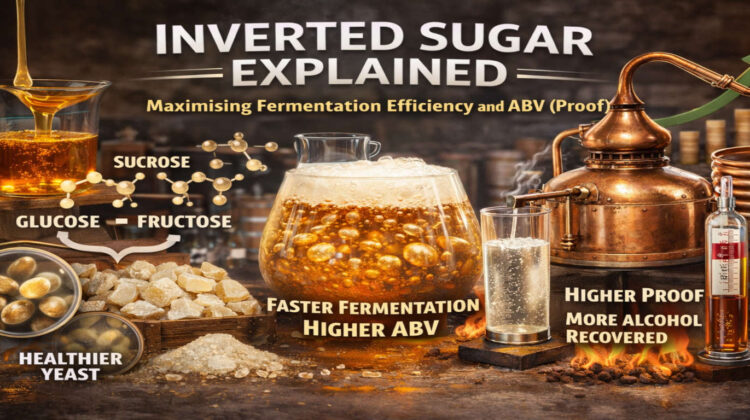
Inverted Sugar: Maximising Fermentation Efficiency and ABV
When you’re running a sugar wash, every kilogram of sugar represents a theoretical alcohol yield. The gap between theoretical and actual is where potential is quietly lost. Inverted sugar closes that gap – not through magic, but through straightforward fermentation chemistry.
🔬 What Is Inverted Sugar?
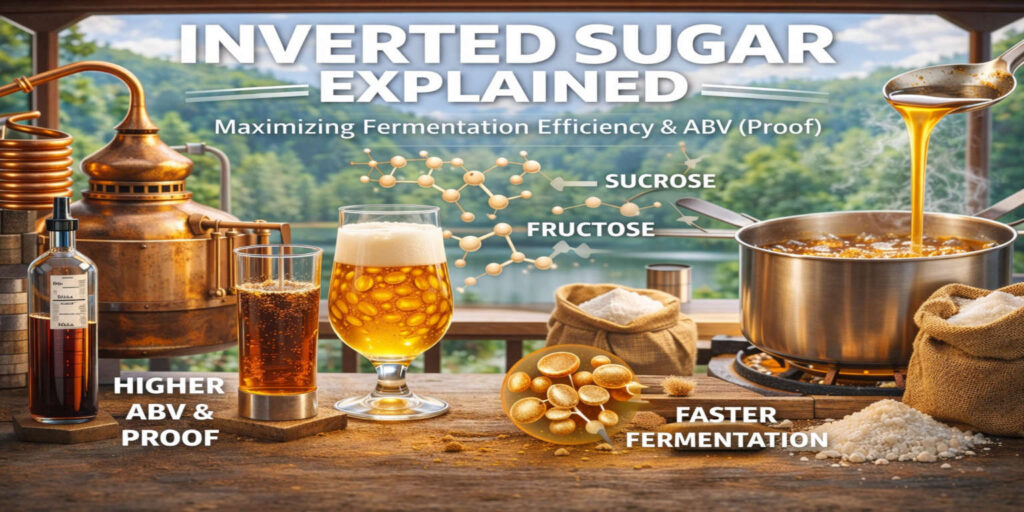
Table sugar (sucrose) is glucose and fructose bonded together. Yeast can’t ferment sucrose directly – they must first produce an enzyme called invertase to split that bond before fermentation can begin.
When you make inverted sugar, you perform that split in advance by gently heating sugar with water and a small amount of acid. By the time the syrup goes into your fermenter, the work is already done. Yeast encounter free glucose and fructose and proceed immediately to ethanol production – no enzymatic detour required.
A small chemical head start. In fermentation, small advantages compound.
⚗️ Sugar = Potential Alcohol
Every kilogram of sugar carries a theoretical alcohol yield – but theoretical and actual are rarely the same. Losses accumulate through yeast stress, incomplete fermentation, and stalled ferments that never reach target gravity. Each means your wash finishes below its ABV potential: less ethanol recovered, reduced proof, and yield left on the table.
🚀 Why Inverted Sugar Increases Realised ABV
Faster start. Glucose is immediately bioavailable, so yeast skip straight to glycolysis. The lag phase shortens, early activity is stronger, and fermentation gets underway sooner.
More complete conversion. Without the invertase overhead, more metabolic energy goes toward ethanol. The result is lower final gravity, better attenuation, and a wash closer to its theoretical ABV ceiling. Even 0.5-1% more realised ABV translates to noticeably more recoverable alcohol per batch – and across multiple batches, it adds up.
Cleaner spirit. Stressed yeast produce fusel alcohols, harsh volatiles, and sulphur compounds. Pre-inverted sugar smooths sugar uptake, supports healthier yeast populations, and delivers a cleaner aroma, smoother neutral spirit, and better hearts fraction during cuts.
🧪 How to Make Inverted Sugar
Ingredients
- 2 kg white sugar
- 1 litre water
- ½ tsp citric acid (or 1 tbsp lemon juice)
Method
- Dissolve – Gently heat sugar and water, stirring until fully dissolved.
- Add acid – Stir in citric acid or lemon juice.
- Simmer – Reduce to very low heat (80-90°C) and hold for 20-40 minutes. A slight golden tint is normal; dark brown means it’s overheated.
- Cool – Completely, before adding to your fermenter.
🧮 Calculator
🏁 Final Thoughts
The gap between theoretical and realised yield is where most losses occur. Inverting sugar improves fermentation completeness, raises realised ABV, and delivers a cleaner spirit – more alcohol per kilogram of sugar, with less wasted in cuts.
Small refinements compound. Invert before you ferment – and let your yeast work smarter, not harder. 🍶

This comment concerns the improved birdwatchers calculator. For a particular quantity of water and the sweet spot amount of sugar, it determined that I use XX amount of acid. Will be inverting my sugar thereby requiring 3 to 4 times the XX recommended amount of acid. The calculator does not account for whether the sugar is inverted or not on its calculation of how much acid is desired. Does the amount of recommended acid used to invert the sugar not alter the final ph of the wash?
Thanks for a good question Duncan. Yes, the amount of acid used to invert the sugar does alter the final Ph of the wash… well spotted! The acid does not “disappear”.
I think that the best advice would be… to use as much acid as you would for the Birdwatchers recipe, when inverting your sugar. Even if you use less acid than the inverted sugar guide suggests, you can still invert the sugar.
I sincerely apologise for not answering sooner.
Rather than giving you a brief answer here, I have published a detailed explanation here.
I hope that helps answer your question adequately?