
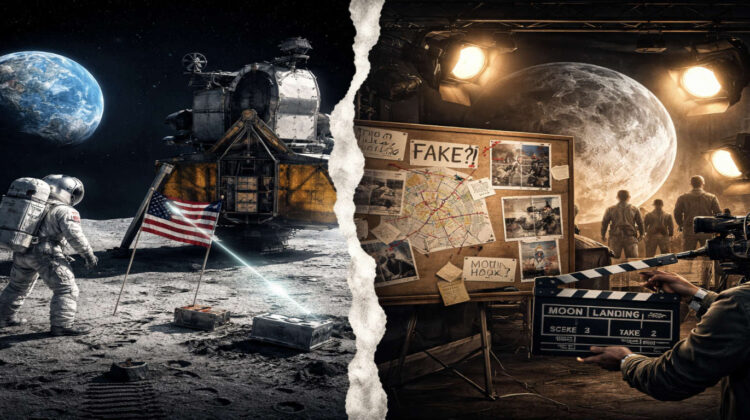
In the wake of the Artemis II mission to the Moon – launched on April Fool’s Day 🙂 – the debate about whether the original Moon landings were fake has resurfaced quite strongly.
🔬 The Case for “Yes, We Did”
On the side of it not being fake, there is a great deal of evidence.
Scientists around the world have independently verified the 382 kilograms of lunar rock brought back by Apollo crews – rock with a mineralogical composition found nowhere on Earth.
Then there are the retroreflectors left on the lunar surface – still quietly doing their job – allowing scientists to bounce lasers off the Moon and measure its distance with remarkable precision.
Not bad for something allegedly filmed in a studio.
🤨 The Sceptics’ Case
Yet conspiracy theorists remain unconvinced. They argue that the technology of 1969 simply wouldn’t have allowed such a feat. In their view, the footage of the “Moon landing” was created here on Earth.
Several familiar arguments tend to surface:
- No stars in the photos?
In reality, this is simply a matter of exposure – the lunar surface is so brightly lit that faint stars don’t register. - Strange shadows?
These are entirely consistent with uneven terrain, reflective surfaces, and the behaviour of light in an airless environment. Wide-angle lenses only add to the effect. - Footprints too crisp?
Exactly. There is no wind on the Moon, which is precisely why the prints remain so sharply defined. In fact, they may still be there in a million years, slowly eroded by micrometeorites.
In short, the “mysteries” are less mysterious than they first appear – provided one brings along a little physics.
👥 The 400,000-Person Problem
Then there is the small matter of scale.
Roughly 400,000 people were involved in the Apollo programme. Not one – not a single disgruntled engineer, underpaid technician, or spurned contractor – has ever disputed its authenticity.
Anyone who has tried to keep a surprise party secret will appreciate just how remarkable that is. Sustaining a deception of that magnitude for over half a century would require something approaching the supernatural.
☢️ Fried by Radiation? The Van Allen Belts
Perhaps the most persuasive argument from sceptics concerns the Van Allen belts – two vast, doughnut-shaped regions of highly energetic charged particles surrounding the Earth.
The concern is simple: surely astronauts would have been fried by radiation while passing through them?
To be fair, this was a genuine concern at the time.
NASA addressed it by:
- Shielding the spacecraft with an aluminium shell
- Carefully selecting a trajectory that minimised time spent within the belts
The results speak for themselves. Data from the Apollo missions showed astronauts received an average radiation dose of 0.46 rad – significant, but far from lethal.
In fact, it’s less than that experienced by some nuclear industry workers, though higher than typical exposure for medical professionals working with X-rays.
🚀 Back to Artemis II
Which brings us back to Artemis II, currently set to carry humans around the Moon on a free-return trajectory – pushing farther than even Apollo 13 managed.
If NASA were intent on faking a Moon mission in 2026, one imagines they might choose a slightly less comedic launch date.
🧠 The Real Question
But perhaps that’s the point.
In a world awash with things genuinely worth being sceptical about, the Moon landings remain one of humanity’s most thoroughly documented achievements.
And yet, the doubt persists.
The conspiracy theorists will disagree, of course.
They’re welcome to take it up with the retroreflectors!
On a lighter note….
What do Japanese men do when they have an erection?
Vote.
😜
The person who invented the umbrella was going to call it the brella …but hesitated.
☂️😂
Why do mice have small balls?
Not many of them know how to dance….
🐁🐭🤣

Leave a Reply